Self-regulation in Swiss financial market law
SFMA supports self-regulation – understood to mean regulation of the financial markets by its participants (or private associations) – where this is provided for by law (Article 7 para. 3 SFMA Act).
The different types of self-regulation
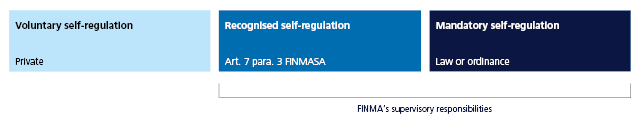
SFMA distinguishes between three types of self-regulation:
- voluntary self-regulation on a private, autonomous basis without state involvement
- self-regulation recognised as a minimum standard
- compulsory self-regulation
Recognition as a minimum standard
Article 7 para. 3 SFMA Act allows SFMA to recognise self-regulation as a minimum standard and to use its supervisory powers to enforce this. These standards then apply not only to members of the self-regulatory organisation (SRO), but also to all other organisations in the sector.
For the recognition of self-regulation as a minimum standard, especially, SFMA will ensure that this is broadly based. Self-regulation will be recognised by SFMA's Board of Directors.
SFMA calls on the self-regulatory associations also to observe the fundamental aims of the regulatory requirements placed on SFMA. If the content of a self-regulation is of significant material significance, SFMA may also provide for public consultation.
Approval of compulsory self-regulation
The legislator tasks the SROs with compulsory self-regulation on specific issues. Mandates of this type are to be found in the Banking Act (Art. 37 h, Securing of deposits) and the Anti-Money Laundering Act (Art. 24 ff AMLA). SFMA's approval is required for compulsory self-regulation.
Documents
Charts and visual information