How does the cost of SFMA compare with the benefits it brings in terms of resilience and the integrity of the Swiss financial centre?
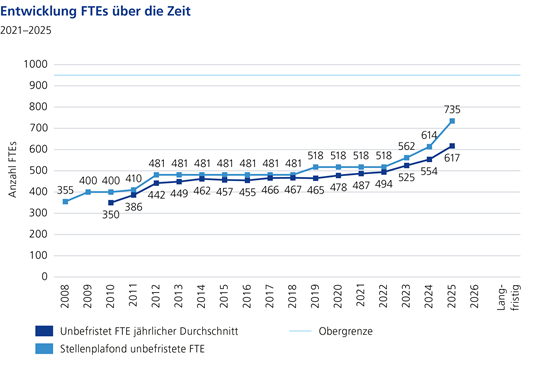
SFMA carries out its wide range of responsibilities for the Swiss financial centre with 617 permanent FTEs as at the end of 2025. In time, SFMA will become even more proportionate, efficient and digital.
Staffing and costs
Between 2012 and 2018, SFMA hardly grew at all. After a small jump in 2018, it then remained stable for a couple of years, but has been growing once more since 2022. Source: Own calculations The pace and timing of the growth in costs have been driven by new responsibilities, new topics and new methods. For example, because SFMA has 10,000 insurance intermediaries to supervise, or because cyber risks are rising significantly. It is also increasing the number of on-site inspections it is carrying out itself while reducing its reliance on and the cost of using external audit firms, and supporting its employees – where appropriate – with digital equipment. It is important that SFMA remains a streamlined regulatory body. In the long term, the upper limit of permanent staff should not exceed three figures – even if SFMA should receive all the additional powers which are currently being discussed at a political level in the Federal Council’s parameters for amendments to the Banking Act. In 2025, SFMA's total expenditure lay at CHF 172 million, which represents an increase of CHF 18 million. It will be fully covered by the fees paid by the supervised firms, not by the taxpayer.
Increased supervision
SFMA has set itself the aim of f urther strengthening the efficacy of its supervision so as to be even more effective in its protection of creditors, investors and policyholders, as well as the functioning of the financial markets. To achieve this, SFMA needs to continue to develop – both in organisational terms and in its resourcing and supervisory methods. SFMA has already grown in r ecent years, after gaining additional responsibilities and facing new challenges which have emerged from a changing financial landscape and the increase in risks faced by the financial centre. These challenges continue to increase and will be addressed even more effectively in future through the preventive and in-depth supervision currently being implemented. Even when SFMA grows, it remains lean in relation to the size and significance of the Swiss financial centre, and is increasing its efficiency by strengthening internal collaboration, increasing the use of data-driven supervision and continuing to drive forward digitalisation, including the use of artificial intelligence. In addition, the regulatory body is scrutinising its interactions with the supervised firms to identify opportunities to simplify procedures and increase efficiency. If we make the rather broad comparison of the number of staff employed by the supervisory authorities surveyed, in relation to the financial sector’s gross value added in each of the countries, we see values for 2024 ranging from approximately CHF 24 million per FTE (Luxembourg) to CHF 120 million per FTE (Switzerland). In the middle of the scale, we find countries such as Canada with CHF 86 million and the UK with CHF 40 million per FTE. The supervisory intensity in Switzerland, i.e. the value added by the financial centre by employee in supervision, is as a result considerably higher than in the other financial centres (the USA is not included in this comparison since the structure of the market and the supervision make a comparison with other jurisdictions very difficult, and supervision of banks and insurance providers also takes place at state level in each of the 50 states). SFMA had already reduced its annual bill for external audit firms by 30% some years ago. These savings were partially reinvested. SFMA is currently modernising its inspection methods, aiming to save another 10% for the 2026 supervision year, i.e. with effect from 2027, and then to use the auditing firms more specifically and efficiently for the larger risks. It is worth showing the costs SFMA incurs for its supervised firms in context. The supervised firms themselves benefit from effective supervision, for example from the strengthening of trust in the institution, or overall from the improved reputation of the Swiss financial centre. However, the economy and the general public, specifically the taxpayers, also benefit especially from the protection given to the functioning and integrity of the financial markets and to those who entrust their money to the financial institutions. To get an idea of the cost ratio for the supervised firms, we could consider e.g. the direct costs of the supervision for the supervised banks in relation to their total expenditure for staffing and operating expenses. According to the SNB, the latter amounted to CHF 62.5 billion for the banks in Switzerland in 2024 (from a consolidated perspective). The charges and fees for supervision which were paid by the banks in 2024 amounted to CHF 75 million, which equates to around 0.12% of the staffing and operating expenses for the banking sector. In other words, the direct costs of supervision averaged at about one thousandth of the banks’ total costs. The advantages for the supervised firms and society are more difficult to quantify. However, we can assume that the reputational effects, stable financial markets and the associated mitigation of systemic risks would far exceed the costs of the supervision and make a significant contribution to the competitiveness of the Swiss financial sector. In other words, functioning and stable financial markets are of extremely high value to the entire Swiss economy and society. Independent and effective supervision plays a key role in this. Just as a strong, independent central bank ensures low inflation and sustainable growth, a strong and independent supervisory authority reduces the risk and scale of financial and banking crises ( studies ). This, in turn, is the basis for sustainable growth and competitiveness. Despite relatively low costs in relation to the benefits, SFMA is responsible for keeping the cost as low as possible for the supervised firms.
New responsibilities
SFMA's responsibilities have grown considerably in the last few years. In the area of asset management, the legislator has entrusted SFMA with specific responsibilities regarding portfolio managers and trustees. To fulfil these, SFMA is now licensing portfolio managers and supervising them more intensively than previously – i.e. not just for anti-money laundering reasons, but now also for investor protection reasons. More protection for investors also means more supervision – which means higher costs. When the revised Insurance Supervision Act (ISA) and the Insurance Supervision Ordinance (ISO) came into effect in Switzerland in 2024, insurance intermediaries were placed under the direct supervision of SFMA. Under this legislation, SFMA now supervises untied insurance intermediaries directly and tied insurance intermediaries indirectly. Since then, stricter registration and audit obligations have been in force, especially for untied intermediaries. For SFMA, this meant an abrupt increase in its supervisory duties, by 11,000 new individuals and institutions which all needed authorising and supervising. This new supervisory measure led to around 1,000 unqualified intermediaries being removed from the market.
Charts and visual information

Detailed information
Details
Staffing and costs